



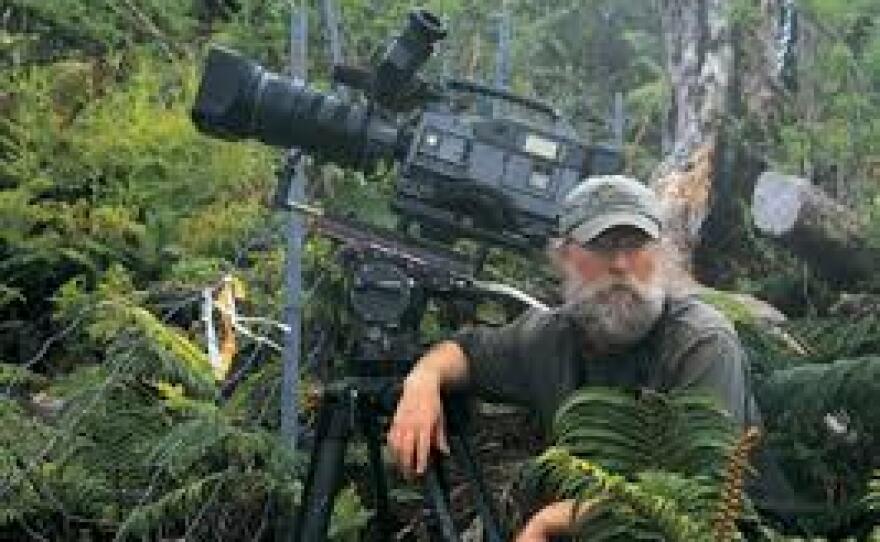
Cliff Shackelford:
Good evening. This is Bird Calls from the Knoll Foundation Studios here at Red River Radio, and we're glad you're joining us. Tonight's program is made possible in part by the Community Foundation of North Louisiana and Willis-Knighton Health.
We invite you to call in with your questions about our feathered friends and the avian world at 800-552-8502. I'm Cliff Shackelford, the host of Bird Calls since 2013.
Operating the board this evening, you'll hear speak is Alaina Atnip. Soon I'll introduce our guest and we'll be ready to take your calls and discuss birds. Let's hear from you by calling us at 800-552-8502. Again, that number here is 800-552-8502.
I think if you translate that, it comes out to the word… i don't know. I've never tried to figure out what 800-552-8502 spells, but it would be fun if it spelled something like Red River, but I don't think it does.
Alaina Atnip:
It might be able to fit it, maybe.
Cliff Shackelford:
Yeah, or maybe Red Riv, something close. But it's probably spells…
Yeah, so we're gonna start off as we always do, profiling a different species, a different one every episode, a different species. And tonight we're going to hear about a small songbird known as the dickcissel. I'm going to spell that D-I-C-K-C-I-S-S-E-L. It's a one-word name like Mallard, Cher, Sting, Prince, Redhead, the duck. So, dickcissel, and the name is an example of onomatopoeia, suggesting the bird is saying its name.
Let's listen to a dickcissel here.
So you got to have a little bit of an imagination with this one, you know, to get that onomatopoeia down. You know, everybody gets Bob White, that one kind of makes sense. Kill deer. But this one, if anything, the bird sounds more like it's saying, zick, zick, sisle, sisle.
So that's where he gets his name, Dick Sissel. The dickcissel is a sparrow-like bird about the size of a house sparrow. Farmers sometimes refer to it as the little meadowlark because it has the yellow and black markings of the familiar Eastern Meadowlark
The male dickcissel has a yellow breast, black on the throat and rusty color on the shoulders. Females have a similar pattern, they're just more washed out and not as vibrant as the males. This bird's diet consists mostly of seeds and insects. The dickcissel is a social and highly migratory species breeding almost exclusively in the US with highest densities in the Great Plains and they barely extend as a breeding bird north into central Canada, barely into Canada. During migration, they can occur in large flocks numbering into the thousands. In winter, those flocks can reach into the millions. Most winter in Central America and northern South America with high numbers in the Llanos of northern Venezuela. When Venezuela's Llanos region was converted to industrial-scale agriculture, millions of dickcissel were flocking there in search of rice and sorghum, and they were considered an agricultural pest. Historical poisoning campaigns using organophosphate at nocturnal roost of dickcissels has devastated the population.
However, managing the farmer-bird conflict by local conservation organizations has helped.
In the US, look for this bird in large native grasslands, overgrown pastures, tall hay fields, and grassy roadsides. Males will sit exposed in the open, often on a fence post or barbed wire or shrubby tree and sing loudly.
To see a photo of a dickcissel snapped by James Childress, please visit the Bird Calls page at redriverradio.org. And I want to hear dickcissel again, because I want people to try to get that name by listening to the sound, let's listen one more time to dickcissel.
Remember, imagination.
He doesn't speak English.
He's a songbird, but somebody, somebody thought they heard him saying the name dickcissel, and that's where that imagination has to come into play to get all the pieces into place there. But that's a cool bird. Very cool bird and we'll talk more about him hopefully here in a minute.
So we have with us tonight a buddy of mine and he is really cool dude. Tim Barksdale from Missouri. Tim, are you there?
Tim Barksdale:
I am. How are you doing?
Cliff Shackelford:
Yeah, so excited to have you. How are things up there in Missouri?
Timothy Barksdale:
Hot, baby, hot.
Cliff Shackelford:
Hot, that sounds like here in Louisiana and at home for me in Texas.
So Tim, thanks so much for joining us and I always like to start off not by me introducing the guest, but by the guest introducing themselves. So who is Tim Barksdale? Tell us a little bit about yourself. Give us a brief biosketch of all the good things that, well, let us know who Tim is.
Timothy Barksdale:
Well, I guess I'd have to start with where I grew up and where I was born. I came from St. Louis, Missouri, originally. And grew up in the country. St. Louis County used to be actually all farms and fields and pastures and woods when I grew up, you could drink out of the springs in the valley next door, and it was just an amazing place to grow up as a kid. We had whippos, Bob Whites, all kinds of stuff right around me. Went to school at a place called John Burroughs, so the famous naturalist, it was named after him. That was kind of prophetic in some way. Then I went to the University of Arizona for a brief period of time. Came back into St. Louis and worked for a living for several more years and went to Washington University and then graduated from Northwest Missouri State University up in Northwest Missouri.
I've been a birder almost all my life. And I'm a professional ecologist and wildlife biologist. Then 35 years ago, a dear friend of mine who's no longer with us introduced me to the concept that I should be doing wildlife films and making films for children and nature and PBS and I had a moment of grace, basically, I don't know how else to describe it. The world completely changed.
Cliff Shackelford:
So, 35 years ago, so tell us, I mean, you know, were you in college then, or were you mid-career somewhere, or where were you in life when that came about?
Timothy Barksdale:
I was. Yeah, good question. I was just so after I ended up leaving the University of Arizona after a brief tenure out there, I ended up coming back and cooking. So I became trained as a chef and after a number of years, I realized that really wasn't what I wanted to do because I loved birds so much I had to do something with that, with birds and wildlife.
And so I kind of started my way back into that through college and got a degree. I got some good jobs, but they paid next to nothing because a lot of wildlife organizations believe that you should work for free, because you love it so much right?
And so the pay is not very good, and it's hard to raise a family on that. And at that time, I was married and had kids.
So, I went back to work in banks. I went into a bank for 6 years and learned about economics and promoted. I was a young executive in the bank by the time I was ready to leave. I did not like banking. I loved working with the people. My clients were fantastic. But I was not someone who could sit there and say, “Oh, you should take this out,” because they weren't going to make any money doing that and I couldn't ethically do that.
So I was working for a nonprofit, and one of my major donors, or the donors for that organization, was the person that had this insight that I should be making films. And so I was about 30, about 39 years old.
So that's been… been the story of my life now.
Cliff Shackelford:
Wow.
Yeah, I don't… I don't know what would happen if I would… when I was 39, if, you know, had the career I was in, if someone just said, hey, you should do a radio show! And, you know, but here I am, I did, about that same time, I think I was 39 or 40, something like that, and, yeah.
Timothy Barksdale:
You'd be divorced and broke just like me.
Cliff Shackelford:
Yeah, but this isn't an everyday paid gig… it’s not paid at all. So this is fun though. And I bet you wanted to get outdoors. If you could just have a if your bank office was outside under a tree, I bet you would have had a good time.
Timothy Barksdale:
No, this is the challenge that so many of us have really in life. And it's earning a living versus doing what you love. And when you can find the combination that works for both of those things, that's the beautiful point.
Cliff Shackelford:
Hmm.
Yeah, yeah, good, good one. Yeah. And it's hard to get the 20-something year olds to understand that when a lot of doors open but which, you know, what's behind door number 3? And they pick number 1 or 2. So yeah, that's a good lesson in life, and hopefully all of us learn that before it's time to retire, cause then it's too late.
So… and I do have to mention to the listeners that I flew up to St. Louis two months ago this day, and you picked me up. You live about 2 hours from the St. Louis airport. You picked me up and hosted me for about 4 days, and we had a heck of a good time bird watching, and namely I was there to look for breeding Henslow sparrow. I've seen Henslow sparrow on the wintering grounds in 4 different states, but never encountered one on the breeding grounds and listened to him live, and I told you about that probably a year ago, and you said, come up, I'll show them to you, and I was like, all right, gonna take them up on it.
Boy, did you slam dunk that ball. And the interesting one we just profiled dickcissel. I remember the first evening we went out listening, there was a dickcissel singing so loud and so obnoxious that I couldn't hear anything else. We couldn't hear anything else, and you're like, oh, I came and scouted, I know there's a Henslow right over there, but that dickcissel was drowning out all the other songs, and if you know the Henslows it's just this little wimpy little and you can't hear that over Mr. Dickcissel singing loudly, but that was a lot of fun. It seems like a year ago, I can't believe that was only 2 months ago, but that was a fun trip.
Timothy Barksdale:
Time's flying, baby, when you're having a good time.
Cliff Shackelford:
So, Tim, tell us what got you hooked on birds and birding. And you mentioned what got you pointed in the direction you are professionally. But yeah, tell and then maybe talk a little bit about birding in Missouri because when I was there visiting you, I was impressed. You knew every corner of the state, as you should, being a traveling bird watcher, but you are talking about doing a big year decades ago, so if you could tell us about that after you explain how you got hooked on birds and birding, I just would like to hear more about your big year in Missouri and how that went.
Timothy Barksdale:
Sure. So, I became a birder at a very young age in rural St. Louis County, we moved out there in 1956, and my dad had built the house with, I’m sure, quite a bit of help. But there was a faucet outside for the hoses, and it was the washer was not seated properly. And so it was dripping. And there was a little puddle water underneath that. And Bob White quail were coming up and I remember mom, literally, I was four years old, and I can remember mom saying, “boys, boys, come here!” You know, and I was looking over the top of my little brother's head and kind of pushing away. And there were these baby bob whites and three adults, and I just will never forget that moment.
And then later on, it was a couple years before I had another real big trigger moment. When I was eight, our parents used to go to this place in Massachusetts and we were dropped off at the Chillmark Community Center, and this man named Edward L. Chalif, C-H-A-L-I-F, was leading a bird walk, and Eddie was one of the world's expert on a lot of different types of birds. And he took us to a field in south of Edgartown, and it was just a prairie. It looked like a prairie. And there were upland sandpipers feeding right next to Hudsonian curlews that are now called Hudsonian Wimbrels.
And I was just mesmerized by the fact that this upland sandpiper, this straight little dainty little bill and a long neck and a fairly small head, and then this next to it was this kind of big burly, you know, Wimbrel going like with a big curve bill, much bigger, much thicker, and I was just flabbergasted by that. I remember going like, what is going on? It was just… just blew my mind. And so, I brought that kind of energy back into Missouri.
And the St. Louis group was a really good bird group. There were some wonderful people that I just adore and love, but they were not the level of birders that I probably should have had at that time. They didn't know how to bird by ear very well and there were other things that we learned as we grew up. Birding is today a far different sport or passion, pastime profession for many of us now than it was when I was a kid. It's very different now. Moved this to a whole new space.
But Missouri became… It was my home and I got married and Katie and I… I kind of got into national birding before I really became a Missouri birder. And so I attempted a national big year but in 1976, I decided to go back to school, and that's when I went back to school at Northwest Missouri State, and I really burrowed into becoming a state birder. And Maryville is way up in the northwest corner, 110 miles north of Kansas City. Exactly opposite type of part of where I grew up. And it was wonderful. Just loved it up there. And so that was one of the things that kind of got me into becoming a state birder. And my major professor was a good birder, very good field man, good ornithologist, good herpetologist, good mammologist. And he was good at a lot of field studies.
So that was why I chose to go up there and that rubbed off, but I stuck mostly with the birds, and started chasing that magic 300 number for Missouri. And it became a step-by-step process and able to see a few rare birds here and there that only show up once or twice in your lifetime. And so gradually that's become a long-term process of mine, almost 50 years now, right? And I'm now the second ranked birder in Missouri. I've seen 399 species in the state and only one or two birds behind the leader.
Cliff Shackelford:
Cool
Timothy Barksdale:
So very, very long process.
Cliff Shackelford:
You didn't mention the professor's name. Are you keeping him…?
Timothy Barksdale:
No, I'm happy to mention Dave Easterly, Dr. David Easterly. Who was just a fantastic person and a wonderful field birder and still living.
Cliff Shackelford:
Okay. Okay, and another name you mentioned, I wanted to back… back up. You pronounce it Shah-LEEF…
Timothy Barksdale:
Shah-LEEF.
Cliff Shackelford:
And for listeners that know there are birds of Mexico. He was the co-author with Roger Troy Peterson on the Houghton Mifflin birds of Mexico. And I always call it SHAY-lif. I thought it was pronounced SHAY-lif. So this is news to me. Shaleef. I've got to change my pronunciation of his name.
Timothy Barksdale:
Yeah, Eddie's family was originally from Russia. He was born into a family of Russian ballet masters. And they fled just prior to the Russian Revolution in 1917 and moved to France. And so they lived in Paris for many years before they came to New York. And Eddie was just outside of New York City and taught ballet and dance in New York City, and was renowned as a master of that. So this was one of his other expertises. He was an amazing guy.
Cliff Shackelford:
Yeah, talk about multitasking. Golly. Interesting. You're listening to Bird Calls. I'm Cliff Shackelford, your host. We have Tim Barksdale joining us as our guest this evening. If you have a question about birds or a question specific for our guest, the number here is 800-552-8502. Again, 800-552-8502. And I want to talk about your profession as a cinematographer before we jump into that. I want to know what the difference is between the words cinematographer and videographer.
Timothy Barksdale:
I think the difference is basically that you're working with a higher quality medium and you're working with a higher quality camera. And that's probably the only difference. There's an American Society of Cinematographers, which I am not a member of. So that's a guild that's out of Hollywood, like the director's Guild or the Actors Guild.
And cinematographers would have, I'm sure, specific things there, but the cameras that we work with are often 50, $60,000 cameras and so… and on top of that, you've got a $50,000 lens on the front of it, if not $100,000 lens. So you've got this amazing level of equipment that is just extraordinary. It's beautiful equipment.
Cliff Shackelford:
Sounds like you've got to be a millionaire to do your job.
Timothy Barksdale:
Or figure out some creative ways to get the financing to do it. Yeah.
Cliff Shackelford:
Yeah.
Yeah. So speaking of equipment, Tim, explain how equipment has evolved over your multi-decade career.
Timothy Barksdale:
I started out with Hi8. And so that looks like absolute garbage today compared to even your iPhone. The stuff I have now is all digital. I am not a film guy. I'm a digital cinematographer and we started off with analog. So the first camera that I bought was the BVW400A Sony camera, shoulder shooting like you would see on a big burly guy on a sports line side of a sports field.
And that was shooting onto an analog tape, a magnetic tape, and then we went to in 1995, Sony came out with the first the world's 1st digital widescreen recorder. So it came out in the same 16 by 9 format that all of our TVs are now widescreen. And I started shooting in that immediately. I sold my camera immediately, bought that other camera and moved straight into widescreen digital.
Since then, we've increased the number of pixels enormously. Those were 760 lines, 726 lines of digital lines. So interlaced NTSC, and we now have progressive that captures like that in every second, just it's so fast it can capture 1,000 frames per second now in some of the high-end cameras. But back then, we were capturing half a line, half a line every 30 seconds, basically… or 30th of a second. And it was a whole different world. Now you look at where the cameras are, it's just absolutely incredible. We've got 50 million pixels, 60 million pixels only announced a 256 million pixel camera not that long ago, which is almost the maximum your eyes can resolve.
Cliff Shackelford:
So they have to start quitting on the overpixelating, huh?
Timothy Barksdale18:23:57
So I hope so, and I hope that'll stop some of this frantic replacement of cameras all the time.
Cliff Shackelford:
Yeah, yeah, speaking of that, because you mentioned this evolution of magnetic tape and then 95, you mentioned digital. So how frequently does equipment become obsolete and what do you do with it once it's no longer functional?
Timothy Barksdale:
Good question. I have in my little vault my storage room where I keep all my footage and tapes. 2 cameras, one of them I paid $26,000 for, one I paid $56,000 for, and they're sitting on a shelf, because they're completely obsolete, and there's no market value whatsoever for either of them.
Cliff Shackelford:
So you have like a little museum in the house for them?
Timothy Barksdale:
That's it. It's my personal museum.
Cliff Shackelford:
Wow, that's amazing. Yeah.
So let's talk about travel because you've got to be carrying cases and cases of equipment, and when I came to visit, and by the way, I didn't mention it to the listeners that you… you successfully showed me a Henslow sparrow so that evening with the cissel, we went back the next morning and boom, there was the Henslows. We even got it to sit up a little bit and watched it sing, and I got some digiscope pictures of it, and yeah, that was fantastic.
So, when I was at your place, you showed me a video that you had done a while back in Ecuador. So, when you're traveling, like, to Ecuador to do a video, how many cases of luggage are you hauling, and what sort of ballpark and weight are we talking?
Timothy Barksdale:
So it can vary. And especially today, our equipment is lighter and smaller, and so it's not quite so bulky of an endeavor. But at times I've had to carry 30 and 40 cases of gear.
And when I went to Venezuela in 1995, I discovered the first orange-breasted falcon nest in Venezuela. In the Tepui region. And I had 30 some cases of gear, Cliff. It was… I don't know what the weight was on that, on that expedition, but one of the times when I flew into Alaska, we flew in a twin otter, and we had to cram, we, man, we packed everything we could possibly get into that twin otter, and it was 1,600 pounds of gear.
So it's it can be prodigious when you're going out to a remote area where you have no ability to charge, you have to carry gasoline or generators or whatever you have to do, and it's… it's big and bulky. You've got to have protection against cold in Alaska, or you know, the heat in a place like Venezuela, so it's… You get into some challenging situations.
Cliff Shackelford:
Wow. So on the Alaska plan, I mean, that's what the equivalent of six or 10 people. You just, did you have to tell them in advance, “don't fill the plane up with people because I'm going to fill it up with equipment?”
Timothy Barksdale:
Those were charter planes. And so we chartered a plane at Prudhoe Bay, the famous oil drilling area. And we flew due west 150 miles into the middle of nowhere. And we landed on a ridge. There was another encampment about a half a mile away in the other direction that was a bunch of researchers. We'd been told this area was really good. They landed with tundra tires on the tundra, big monster fluffy tires. We unloaded all the gear, and we carried it down to the creek. My assistant, myself, and we spent 33 days camped there in paradise. It was absolutely amazing.
Cliff Shackelford:
Wow. And I assume that was May, June, July, somewhere in there.
Timothy Barksdale:
The very end of, let's see, the first week of June, and we ended up leaving about the seventh or eighth of July, the 10th of July, I think it was.
Cliff Shackelford:
Yeah, wow. Oh, interesting. You're listening to Bird Calls. I'm Cliff Shackleford. We have Tim Barksdale from Missouri joining us as our guest this evening. The phone number here, if you have a question about cinematography and travel, the number here is 800-552-8502, and until we get any calls, I have some more questions.
So, since you go around the world filming or recording birds, what's the rarest bird that you've ever filmed, and tell us a little bit about that encounter. And actually is filmed not the right word anymore? That's not the right verb, right?
Timothy Barksdale:
Well, we still use filmed because that's the name of the media, basically. And so it's movies and films and we make films, even though they're digital films.
Cliff Shackelford:
Yeah.
Timothy Barksdale:
The bird would probably have to be the Jocotoco Antpitta. I'd have to say that's the rarest because there are only 50 of those in the world. And that was the subject of the Ecuador film that I showed you. And the Jocotoco was quite an expedition that we took into Ecuador as well. There had never been film before and never been almost seen before. Most of those Antpittas in Ecuador at that time in 2000, late 2005 and early 2006 had never been seen by people, and a man named Angel Paz, P-A-Z, came up with a technique of feeding worms to antpittas and started taming them
And that gradually caught on. But when I went down there in 2006, it had not spread beyond him yet. And so this Jocotoco Antpitta in southern Ecuador, almost on the Peruvian border was an unknown quantity and they'd seen it kind of going to this compost pile enough times that they said, “oh, if you wait there long enough, you'll be able to get it.”
Famous last words, right? And so we spent a week in the rain, in the clouds, and the mists, and it was miserable, and we didn't see or hear a thing.
Cliff Shackelford:
Yeah.
Timothy Barksdale:
And then we went to visit Angel, and Angel had developed this technique, and I'd heard a little bit about him from Victor Emanuel, and I was still not quite a believer, but we got up there and Angel was simply amazing in what he had done.
And literally, I called up the people at the Jocotoco Foundation and said, “you need to send your guy from Tapichalaca up to visit and work with Angel.” And seven months later, we flew back to Ecuador again and we filmed the Jocotoco Antpitta first time.
Cliff Shackelford:
He had trained it with the feeding.
Timothy Barksdale:
He was literally just getting him out of the forest.
Cliff Shackelford:
Very cool.
That's awesome. Where on the planet are quality videos lacking that show the local avathon? In other words, if you were an up and coming cinematographer and you liked getting dirty and sleeping on the ground and roughing it, where would you tell that person to go because there's just nothing in existence for that part of the world?
Timothy Barksdale:
I would say that there has been a rapid, very rapid change in this in the last 10 years. I would have said initially that South America was probably the place to go. But I think that may be shifting. And I… I think there's probably no good answer to that, Cliff because everybody has cell phones now and everybody has learned about digitizing and eBird in particular has really changed things. So we have, we have a lot of capabilities now, but I think that is a really tough question. And I think I'd probably say it's probably somewhere in maybe outback Australia or maybe somewhere like in Southeast Asia, some remote corner of Burma or Laos, something like that.
Cliff Shackelford:
Or Papua New Guinea, maybe it's certainly…
Timothy Barksdale:
Yeah, Papua New Guinea would be a really good
Cliff Shackelford:
Certainly 10 years ago would have been really hard. Yeah.
Timothy Barksdale:
There's not good quality video of Papua, and I was looking at some of the stuff on that recently, because I'm considering going to Papua New Guinea…
Cliff Shackelford:
Why are you coughing?
Timothy Barksdale:
Because I'm giving away one of my potential next places I want to go!
Cliff Shackelford:
Oh, okay, because that was my next question. What location high is highest on your bucket list to film birds? And you just review it?
Timothy Barksdale:
Well, no, that's not it, though, exactly. So your question is still pertinent. My number one bird in the world that I want to go film is Little Curlew. And so I'm actually just about ready to go book a trip back to Darwin, Australia.
Cliff Shackelford:
Oh, okay. Well, go ahead.
Timothy Barksdale:
The funny thing is, is that if you listen to my stories, you'll hear this pattern of going and trying to do something and no one else has ever done before. And then not succeeding.
There's often a lot of failure involved in wildlife filmmaking. It takes a lot of patience and just plain dumb persistence. Gotta really be tenacious in wanting to get that bird. So I'm going back to Darwin and we're gonna… I'm gonna work with a local man who has offered me some assistance. He's an outstanding birder, and he knows the area cold, and I'm going at a better time of year.
And then I'm going to go to India, and then I'm going to go to Thailand because I really want to film in late November spoon-billed sandpiper, the little bitty coonies, yeah.
Cliff Shackelford:
Very cool. And is there a wetland that's consistently getting them in migration?
Timothy Barksdale:
Yeah, at the end of migration, they're wintering south of Bangkok in a nature reserve. There's a good spot there in the end of November. And I will be sitting on beaches in who knows how hot, but probably about like it is outside right now, right? 95 with high humidity…
Cliff Shackelford:
Yeah, yeah Yeah, holding equipment and yeah, yeah. Oh, yeah.
Timothy Barksdale:
…bitten by flies. The one thing you've forgotten to mention are the leeches, the ticks.
Cliff Shackelford:
Yeah.
Timothy Barksdale:
The other part of wildlife filmmaking that is challenging, bugs. And the worst bugs I've ever had were up in northern Quebec. I spent a summer on the Ungava Bay, just south of the bay itself, on the Koksoak River. And filming peregrine falcons and Gyrfalcons, and the bugs were horrendous.
Cliff Shackelford:
Really? So you had mosquito jacket and mosquito heading and it's still, you probably still could hear him buzzing, trying to get through.
Timothy Barksdale:
Not only that, when you lifted up the mosquito netting to try to feed yourself, you got assaulted by bugs that would be flying in through your underneath your netting and biting you on the neck while you're trying to get a spoon of food in.
Cliff Shackelford:
Yeah, or a swing of water, huh?
Timothy Barksdale:
It was unbelievable
Cliff Shackelford:
Well, that was my next question. Where has been your most challenging shoot and why? And I think you just answered it. So you said it's northern Quebec, huh?
Timothy Barksdale:
That's one of them. I mean, there's a list of them.
Cliff Shackelford:
Oh.
Timothy Barksdale18:35:56
I would say that on Kauai, when I was up in the Alakaʻi swamp, and we got in there on a day when it only rained a little bit, but for the next 5 days solid, it rained and didn't stop for 5 days, literally buckets of rain. I remember lifting up the portal of the tent, the huge tent that I was in a completely waterproof tent. Thank God.
And I saw my first Poʻouli on one of the thrushes underneath the tent, and then it finally stopped. And in that one hour that it stopped, I got all the rare birds in Kauai in that one hour, in that one location.
Cliff Shackelford:
This is Hawaiian Islands you're speaking. Yeah, very cool.
Timothy Barksdale:
The Hawaiian Islands. But that's a very big challenge.
Alaska, I've told you a little bit about the challenges there, the cold and the remoteness, the fact that you're eating on freeze-dried food and just add water and cooking it for 30 days solid, you… we each lost 15 pounds on that trip, my assistant myself. Plus the tussock grasses. You're in a frozen environment. And so the grasses grow completely differently. They're like big clumps, and they're so they grow close together, and you never know quite where your foot's gonna land, whether you're gonna be on the edge of the tussock, or on the middle of the tussock, or if you're on the edge and you're just going to fall down, and so you… we each came out of there in great shape, but beat up.
And there have been moments when you're trying to get something on the edge of a hill or a cliff or something, and you're just trying to do something a little bit, you know, and these cameras are not lightweight. They're 25, 35, 45, 55 pounds, and so, depending on what year you're talking about. But I remember struggling one time with just trying to get my tripod and my camera up into a safe position and it almost just went down a cliff. You know, $100,000.
Cliff Shackelford:
Oh, jeez
Timothy Barksdale:
I'm just about to fall off of a cliff, and you're just with your last fingernail and your last ounce of strength, just making sure it gets up there before you just can't do it. And so there's lots of challenges.
Cliff Shackelford:
Yeah. You mentioned the airplane. You said that it had fluffy tires, you called them Tundra tires.
Timothy Barksdale:
Tundra tires.
Cliff Shackelford:
So I can't just go to my local BFGoodrich and get some of those for my pickup truck.
Timothy Barksdale:
Probably not. I don't think so, yeah.
Cliff Shackelford:
Probably not. What if I pull up in a Toyota Tundra? They have tires. That's not what you're talking about. Okay, I get you. Gotcha. Gotcha.
Timothy Barksdale:
No, I don't think so.
Cliff Shackelford 18:38:42
Hey, so you just mentioned almost losing your equipment off the edge of the bluff there. What horror stories do you have to share about equipment loss, damage, or heaven forbid, stolen? Do you have any good horror stories?
Timothy Barksdale:
I've been really lucky. I mean, I haven't had any major, major things stolen. I've had other horror stories where like when I found Orange-Breasted falcons in Venezuela, we left for a week to go get some more gear and a blind that I could hang over the edge of the cliff and suspend from the top.
And while we were gone, the natives decided that they wanted to remove a tree, and so they threw rocks down the cliff and scared the birds completely away. So there's things like that that happen. Venezuela was also in that day, in the 90s, 94, 95,
Cliff Shackelford:
Hmm.
Timothy Barksdale:
This is prior to Maduro and Chavez, but there were still machine guns at every major intersection out in the rural areas. There were two guards with machine guns. So you're in these interesting areas.
Argentina, when the first time I went to Argentina, I flew in. I had talked to Mauricio Rumboll, the major and the great ornithologist from Argentina. But I hadn't pulled any strings or anything like that, and so I went through customs and they're looking at my equipment and going like, “well, you can't bring that in here.”
I'm like, “well, I've got to, I've got to film these golden plovers down in Pampas,” and they said, “nope.” And they…
Cliff Shackelford:
They didn't know what it was? It looked like military equipment or something to them?
Timothy Barksdale:
Oh, they thought I was going to go…they thought I was going to sell it. They all think about profit and gain. And so they thought I was going to sell it to somebody and for cheap and get away without paying taxes on it and stuff.
Cliff Shackelford:
Oh, yeah.
Timothy Barksdale:
I was just going to film birds. They couldn't figure that out.
Cliff Shackelford:
Did you finally get through?
Timothy Barksdale:
Yeah, it took me a week and I ended up meeting the Secretary of the Interior.
Cliff Shackelford:
Really?
Timothy Barksdale:
I got permission. Yeah.
Cliff Shackelford:
Well, that's a good story right there. I'm sure you weren't happy about it when, you know, eating up a week's worth of time trying to get paperwork stuff done and getting your approval and all, but that's a cool story for today.
Timothy Barksdale:
Yep.
Cliff Shackelford:
Yeah.
You're listening to Bird Calls. I'm Cliff Shackelford. We have Tim Barksdale in the house, and he's got some cool stuff to talk about. And if you want to ask him about cinematography and traveling to film birds, you better hurry. The number here is 800-552-8502 or if you just have a general bird question, we can answer that for you as well. So that number is 800-552-8502.
So, Tim, I suspect there are a lot more nature photographers out there, even amateurs, than there are cinematographers. Are the environmental conditions, like available sunlight, the same when doing cinematography as it is with general photography, and how are the two crafts different?
Timothy Barksdale:
That's a very good question. So cinematography, people shoot at 24 frames per second or 30 frames per second. And our new cameras can do up to 120 frames per second. So this little camera that looks like a DSLR, just a standard Sony camera can shoot 120 frames per second of 4k.
So that's 3,800 frames by 2160 vertical and that's amazing from what I started with, right?
But most of the stuff is pretty much the same. You're dealing with iso. You're dealing with the speed of the frame capture. So a still photographer is thinking in terms of a thousandth of a second or high speeds in order to freeze that image. They want that bird primary or feather, every feather to be frozen and not moving. So they're trying to get high frame rates. We can't deal with a thousand frames per second when you're dealing with motion because then it just looks very choppy, very, very unprofessional.
And so it's a different art form than still photography. But the basic parameters are basically the same.
Cliff Shackelford:
What about the soundscape, though? The photographer's not trying to get the quietness that you are, you know, you got distant airplanes and trains and dogs barking, so that's got to be a headache. All these man-made noises that can really muck things up, right?
Timothy Barksdale:
Absolutely. We now try, yeah, we have to think a lot about soundscapes. One of my microphones is a 16 encapsulated microphone. So it's got 16 little spiral patterns of microphones around one rod. It records surround sound and 7.1 surround sound, and it is so sensitive, it's just ridiculous. And you have to look at that for the building soundscapes.
So, that's a very different art again than still photography. And you know, when you look at things online that's where the difference starts to come up in my mind. We don't shoot vertically. So TikTok, Instagram. Sorry, baby. Doesn't work for me at all. We shoot. We shoot widescreen, we shoot… think of landscapes and immersion, how to immerse and how to capture a natural landscape…
Cliff Shackelford:
Oh, yeah, that's true.
Timothy Barksdale18:44:37
…and to immerse our viewers in that landscape.
Cliff Shackelford:
So in the editing, let's go back to the soundscape stuff.
Timothy Barksdale:
Yep.
Cliff Shackelford:
Are you… are you diligent to get rid of those sounds? Can you edit out? Now that things are digital, right, you can get rid of that airplane that's going over that's ruining it, or the dogs way off. No? Okay.
Timothy Barksdale:
Not really. No, it's very difficult. That's an enormous amount of work to remove stuff from things. It's better now than it used to be, yes, but when you're capturing on every one of those microphones, for instance, 16 microphones going in, you're getting a little bit on every one of those microphones.
Cliff Shackelford:
Yeah.
Timothy Barksdale:
And so you've got different channels that still have traces of that sound and it's a nightmare.
Cliff Shackelford:
Yeah, and it's hard to get away from those man-made sounds for sure.
Timothy Barksdale:
You have to plan it carefully.
Cliff Shackelford:
Yeah, Tim, we've got someone on the phone. Alaina, who do we have?
Alaina Atnip:
We sure do. We have John Michael from Houghton, which is where I'm from.
Cliff Shackelford:
Really?
Alaina Atnip:
Yes.
Cliff Shackelford:
Well, you guys can talk about that.
Alaina Atnip:
John, what do you have for us this evening?
Caller John Micheal:
Hi, how do you do? So I'm a naturalist and I only tinker with birds, but I'm a little bit bothered by the wing flashing behavior of mockingbirds, and so I've read in the literature as best I can from Audubon through the Birds of the World and things like this, and I've even gotten up to 2026 with my research and seen the results of studies where students darkened the ventral surface of the wings so that they don't have the white patches.
And repeatedly, studies are finding neutral or negative correlation between the bright white lean patches and foraging success, or hunting success, only with certain insects or invertebrate groups like earthworms which can't easily see anyways, but only detect changes in light or pattern.
Do they see any change in food collection for provisioning young? This is befuddling. What is it for? The only thing else I can think of is that maybe the dorsal surface of the wing is meant to convey to the young which watch on how to hunt. They're a cue to the young, “look at me, I'm over here hunting in this short grass.” I can't see any association with shadows. What is it about? What do you think? What's your thought?
Cliff Shackelford:
So, let me ask you, John Michael, you brought up a very good topic, and you definitely have done your homework, so good job on that!
This is radio. It's hard to describe in a few words what you're talking about. So for the listeners that are listening in, why don't you describe what we're talking about, kind of go through the motion of a mockingbird.
Caller John Micheal:
Yes, there's a behavior where mockingbirds will land almost always in short grass, almost always in open sun, and this is based on ecological studies where they track the conditions, and they will cock their wings in between one and five steps from the low position tucked against their side upward into a banner position, you know, maybe a 120 degrees out above their body on each side, and they seem to be revealing this kind of moth-like pattern of blackish gray and white patches on the undersides of their wings, or perhaps in my explanation, the backs of their wings.
And they do this during foraging behavior. They'll take a couple steps, one, two, three, cock their wings, one, two, three steps cocking them, and then close their wings, step forward again, and repeat the behavior over and over again. And sometimes they have hunting success, but statistically, they don't have more hunting success when they exhibit this behavior.
And when you darken their wings, it doesn't change their success positively, negatively. Sometimes it changes it positively. So this leaves us confused about why they perform this behavior. Admittedly, all the mimic thrushes wing flash in one way or another. They all do some sort of wing flashing, as best we can tell, it's synapomorphic. It's something they all share.
But why? Why does the mocking…
Cliff Shackelford:
Yeah, that's a good question. And again, man, you have done your homework. I'm impressed. I think you ought to think about going… I don't know where you are in life, but how about college or grad school and doing a thesis on this.
Caller John Micheal:
Professional botanist.
Cliff Shackelford:
Okay.
Caller John Micheal:
With naturalism professionally, but I don't have time for an ethological stuff. There's plants to deal with.
Cliff Shackelford:
Well, and we, yeah, we need every botanist we can get, because there's plenty of bird people out there, but we need more, especially entomologists, bug people.
Yeah, good job on being a botanist, because every bird requires plants to sit on, make nests out of, feed on them, etc.
So, birds need their plants, but let's get to your question. I've read the same thing you have that, you know, well, let me talk about when I first read it decades ago, they thought it was to spook pray. And that when they flash that white that the bug hiding in the grass would jump and go, “oh, what was that?” And the mockingbird could find it. But then I've read, like you, and found that that doesn't work.
I don't know what the answer is. Maybe they just have a nervous tick, you know. I don't think evolution allows nervous...
Caller John Micheal:
But I do wonder what you think of my idea that, like the darkened tips of a lion here, they signal to the group, in this case, that little young that follows them around from, I don't know, two to four weeks, and cheeps and stares at them, and then they come back and provision it. Do you think it's possible that the dorsal surface is a symbol, a signal to the young, as opposed to…
Cliff Chackelford:
Well, the adults are doing it year-round, and they don't have the young with them year-round, so I don't…
Caller John Micheal:
They do it statistically more often, so say the studies, which I did perform during the provisioning.
Cliff Shackelford:
Interesting. Okay.
Timothy Barksdale:
I would venture to, can I chime in for a sec?
Cliff Shackelford:
Yeah, go ahead, Tim. Go ahead, Tim.
Caller John Micheal:
Yeah.
Timothy Barksdale:
I would say that there could be something going on that we can't see, also. Birds can see ultraviolet light, and we cannot. And so there may be other things going on that we're simply not aware of that are being displayed there.
And, you know, that's the beauty of natural history is that we do not know everything yet. And I think it's one of the things that, as I've gone through life as a budding ornithologist to some kind of level of ornithologist here that we just don't know everything yet.
Caller John Micheal:
Well, if I had to test it, I think I would darken the outer surface of the wing next. That would be my next trial. But it is worth considering. Maybe if we shine a UV light on some specimens we'll find that the mockingbird has UV fluorescence that we haven't yet discovered.
Cliff Shackelford:
Good response Tim. Yeah, this is a good question John Michael.
Timothy Barksdale:
Very good.
Cliff Shackelford:
And I appreciate you talking about this and doing it so eloquently, so very good. Are you as good a botanist as you are an ornithologist?
Caller John Micheal:
Oh, I hope I'm a better botanist than…
Cliff Shackelford:
Well, you get an A plus from me, my friend.
Caller John Micheal:
If you figure it out, you call me, okay?
Cliff Shackelford:
Yeah, very good. Hey, thanks so much for the call, that was great, thank you.
Yeah, maybe you got something there, Tim. Is it too late for you? Go back to grad school and research this?
Timothy Barksdale:
Oh, I'm not, yeah. I've got… I've got travel on the mind here.
Cliff Shackelford:
Too late, huh?
So when you were 39, someone told you what to, you know, gave you a path that you thought, “hey, that's cool.”
I can't do it, I can't convince you to go back to school and do this as your Master's project?
Timothy Barksdale:
I've thought about it, but you're gonna have to wait another 10 to 15 years and I'll be the oldest graduate student in the country.
Cliff Shackelford:
You have too many films to make between now and then. I got you, I got you. So you showed me…
Timothy Barksdale:
Yeah.
Cliff Shackelford:
…your Ecuador footage, and I have a greater prairie-chicken video you did. Where can listeners go online to preview some of your work?
Timothy Barksdale:
So I am terrible on my own websites. I am not a good self-promoter. So anybody out there who wants to do volunteer helping me promote what I'm doing, just you know where to find me. But the Macaulay Library at Cornell Lab of Ornithology has almost 23,000 clips of mine online.
Cliff Shackelford:
Wow
Timothy Barksdale:
And Birds of the World. There's a lot of my material online in the species accounts, and I noticed the other day, particularly in Hawaii and in Cuba, the Cuban birds, I'm very well represented there still.
So they had 42,000 clips of mine online at one time. And this to me indicates the advance that's happening to the average person out there. We're getting a lot of good material coming in from just iPhones and from these wonderful new cameras that people are able to buy at moderate prices.
Cliff Shackelford:
Neat. So we got just a few minutes left. So that leads me into a question of what do you recommend interested listeners to do when they want to get started filming nature? Is the smartphone where to begin? What do you suggest?
Timothy Barksdale:
I'd say start in your backyard. Absolutely. Find a story. The thing that is going to make you and keep you interested and get you some recognition is learning how to tell a good story.
And because right now everybody is kind of doing their own thing. We're doing this Instagram, TikTok, and all these little videos online, and you need to learn how to tell stories with good beginnings, middle, and end and questions. So just like our friend John Michael there had a really good question. Try to find a question that you don't know, and then find a good story on how to explain that to other people and help other people with that.
And pick something simple like a Mockingbird or a robin, do time lapse. Do something that's interesting and make something interesting to your neighbor. What would your neighbor be interested in? Because I think everybody has a natural interest in birds and nature and I think if you learn how to tell a good story and do that visually, that's going to be the key to becoming a good filmmaker.
Cliff Shackelford:
Great. Yeah, that's good advice for people that want to get into this. So, okay, real quick, birding in Missouri. What's your favorite place to go and why?
Timothy Barksdale:
One of my most favorite places is the Riverlands. It's St. Louis, it's north of St. Louis on the Mississippi River. There's peregrine falcons that nest nearby. One of the things you asked me about that I didn't get a chance to answer was my big year in 1991 the final day of my big year, Dec the 31st, I broke the… set the first big record for Missouri at that point in time, and my 314th species was there, and it was one of the rarest birds in North America at that time, the Ross's gull.
And I found it at that location. So that's one of those favorite places. And I love the rivers that we went down to though, Cliff, the 11 Point River.
Cliff Shackelford:
Yeah, that was beautiful.
Timothy Barksdale:
They're fabulous places.
Cliff Shackelford:
Yeah, you showed me blue-winged warbler on territory, cerulean warbler on territory down there. And that was a fantastic place. Yeah, I was impressed with, I mean, I've been to Missouri, but not in the detail and, you know, the rural spots that you took me to, that was fantastic. And those prairies that had Henslows and dickcissels and and all the other birds in there, common yellowthroats and red-winged blackbird, those were just beautiful up there.
Yeah, great, great state you're living in in Missouri. And Tim, thanks so much for being on the show tonight. We learned a whole lot and super interesting, your travel analogs. I mean, I'm thinking an autobiography of your travels. I mean, that would be really interesting, because you're not just traveling with a pair of binoculars, you're carrying equipment, and like you said, you're telling a story.
Timothy Barksdale:
People are starting to encourage me to write something. So I think it's probably going to happen.
Cliff Shackelford:
Yeah, very good. Well, thanks for being on the show tonight. Thank you, Tim.
Timothy Barksdale:
Thank you.
Cliff Shackelford:
So that concludes this evening's show, which is our 131st episode. You've been listening to Bird Calls with me, Cliff Shackelford, resident ornithologist here at Red River Radio Studio, and our guest via Zoom has been Tim Barksdale of Missouri. Thanks, Tim.
This show has been made possible in part by the Community Foundation of North Louisiana and Willis Knighton Health. Tonight's episode was assisted by Alaina Atnip and there were volunteers operating the phone bank.
Tonight’s sound file of dickcissel was recorded by Mike Nelson and can be found at the website xenocanto.org. The photo we used of this songbird on the Bird Calls webpage was snapped by James Childress.
This show will be available soon as a podcast on our website at redriverradio.org, as well as from the National NPR app.
If you have a photo or a sound clip of a bird that you'd like me to identify, you can send an email to redriveradiomail@gmail.com. Again. RedRiverRadioMail@gmail.com.
Hey, be sure to join us for the next episode of Bird Calls next month at 6:00 PM on Tuesday, August 11th. Do it for the birds.
