Picture this...
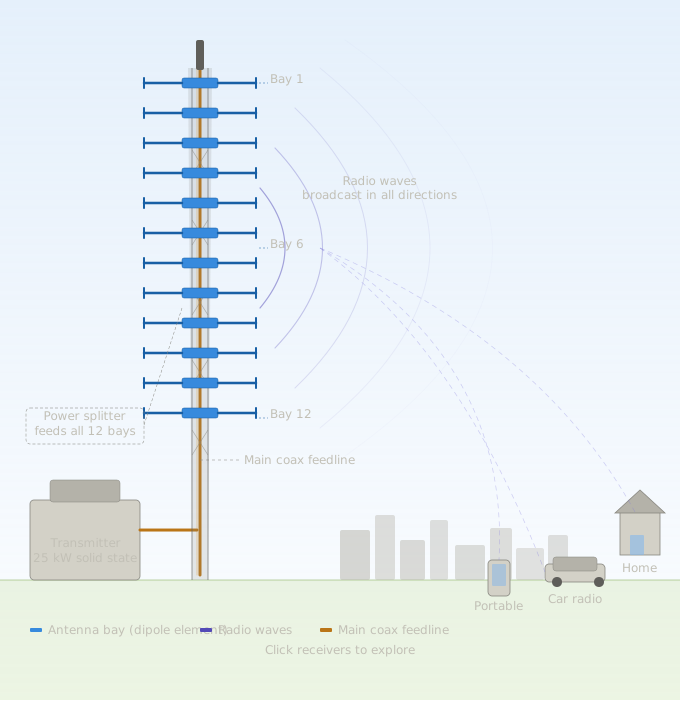
Somewhere on a hill, or tucked behind a radio station tower, sits a cabinet about the size of a refrigerator — and out of the top of it and through a big long piece of pipe filled with nitrogen, it pumps a screaming 25,000 watts or so of electromagnetic energy into the atmosphere through the air to your radio antenna out of it's speakers and into your ears...in about an eighth of a second.
Every song or show you've ever heard on FM radio passed through something like this. That's enough raw RF power to illuminate an entire neighborhood. And it's doing it right now, 24 hours a day, 365 days a year, without missing a beat (almost).
By now you've guessed I'm describing one of our HD Radio transmitters, and they are one of the most sophisticated pieces of broadcast engineering on the planet.
Here's the REALLY good news
Beginning on the morning of Tuesday 04-21-2026 KLDN 88.9 FM is getting a new solid state transmitter. This project has been months in the making and is coming to fruition quickly and will take a team of folks to get it installed.
This modern device sits at the base of the tower and is used to convert the signals we send to it from the studios. The new device weighs about 1,235 lbs in a single box cabinet and requires special delivery and installation and was routed all the way from Bangor, Maine. It replaces the older transmitter cabinet which weighs approximate 775 lbs and the high voltage power supply cabinet which weighs around 1300 lbs.
The installation will require us to decommission the current transmitter, taking it offline and off the air for a bit and moving it out of the transmitter enclosure and moving the new one in. We will then position and connect, energize and test the new one. If you hear some static or noise over the next few days, just know it's us working to install the new gear.
Remember: You can always listen online by clicking on our streaming links from our streaming links page.
So what IS an HD Radio Transmitter?
HD Radio is an in-band, on-channel (IBOC) system — a hybrid method of transmitting digital AND analog signals simultaneously on the same frequency.
The new digital signals we broadcast are in the same FM band, associated with the existing radio channel. So on one hand, you have the familiar analog FM waveform — a single, beautiful continuous wave, exactly like radio has worked since the 1940s. And flanking it on both sides, hiding in the spectral shoulders of the channel like digital ninjas, are the HD Radio "subcarriers".

So why are we upgrading? THE OLD GODS: Tube Transmitters
Imagine this: a ceramic glass bottle the size of a fire hydrant, glowing an eerie orange-red, scorching hot to the touch, drawing so much electricity that it hums with a physical vibration you can feel in your chest. This is a high-power vacuum tube — specifically something like the tube we are currently broadcasting on — and it was the titan that powered AM and FM broadcasting for decades.
Inside the tube, electrons are boiled off a heated cathode at around 780°C — hot enough to glow. The cathode is coated with a mixture of barium oxide and strontium oxide, sometimes with calcium oxide, heated to about 780 degrees Celsius (1,400°F). This causes barium and strontium atoms to diffuse to the surface and emit electrons. Those electrons are then hurled across a vacuum at enormous speed, controlled by a grid voltage derived from the incoming audio signal, and slam into a plate (anode) to produce amplified RF output. It is, in essence, electron artillery.
The problem? These tubes do burn out like a light bulb. A catastrophic failure — a crack in the glass envelope allowing air in — can destroy a tube instantly. They're fragile, they're expensive, and they're running at plate voltages that could vaporize a human being. Replacement tubes can cost up to $40,000 over a transmitter's typical life. And tube transmitters typically convert only 50–60% of their input power into usable RF — the rest bleeds away as tremendous, wasteful heat. The output of a normal tube transmitter is around 130 to 150 degrees Fahrenheit.

Solid State (of the Art)
Now forget the glowing bottle. A modern 25kW solid-state transmitter doesn't have a single vacuum tube. Instead, it contains hundreds of wee baby transistors — small, cool-running silicon chips, each amplifying a slice of the signal — and combines their outputs through precision power-combining networks to produce that same thunderous 25kW output.
Stack ten of these modules in a cabinet and you have your 25kW. It's like replacing one massive, temperamental cathedral organ with hundreds of tiny, perfectly-tuned instruments all playing in perfect unison.
The efficiency leap is staggering. Modern FM solid-state transmitters are designed to be highly efficient, often achieving energy efficiencies greater than 70%, compared to 50–60% for tube-type transmitters. A larger proportion of input power is converted to RF output power, reducing overall energy consumption. They are LITERALLY cooler to have.
The other great part? With a tube...one crack, one failed seal, one burned-out cathode — and the station is dead silent. But if one of those cool little baby transistors fails, or even several, the remaining modules keep the signal flowing. The transmitter doesn't go silent; it barely flinches.
What This Means for YOUR Ears
The solid-state transmitter's precision is what makes HD Radio's digital signal truly sing. The new solid-state transmitters feature digital tools that ensure the digital signal remains surgically precise.
Solid-state transmitters are optimized and designed for HD Radio. The result for you, the listener? Crisp, CD-quality audio. No hiss. No fading on the highway. Seamless blending between digital and analog when you drive out of range. And — crucially — our station will never go off air because of a burned-out tube at 2am.